


Your post-trade operating model holds everything together. And it runs on the strength of human judgement.
But those valuable minds are often directed at repetitive manual tasks instead. Core, high-volume, standardised data flows through your middle and back office with barely a human touch. But the edge cases, the exceptions, the account quirks that live only in your analysts' heads - these have always required human intervention.
The technology to automate that kind of complexity simply didn't exist for a long time. That's now changed.
Agentic AI closes the capability gap that held the whole industry back, and for the first time you can rebuild the operating model around what your people do best. We call the destination agentic Operations. Autonomous, governed AI handles the heavy lifting of wrangling your most complex data, while your teams get their time back for judgement and the decisions that only they can make.
This article maps the route. We'll look at why agentic AI finally makes a new operating model possible, walk through the five stages of agentic maturity - using reconciliation as an example - and explore how to beat the blockers you’ll encounter on your journey.
The operating model the industry needs
Agentic AI is enabling a new kind of operating model: one that will help post-trade keep pace with the business it serves.
That’s historically been a challenge. The traditional operating model is built from layers of legacy platforms, stitched together over decades. This is all held in place by the manual effort of skilled people working across tools like Excel. It was never built for the speed the business now demands.
That's where agentic AI changes things. You don't have to rest your success on people spending their days on repetitive work that never made the most of their expertise anymore.
Let’s look at why.
Why agentic AI succeeds where other tools fail
Complexity and context had stood in the way of automation in Operations for years. High-volume data in a standardised format carries very little context beyond what the format itself encodes, which makes it a natural fit for rules-based processing.
But context grows with complexity. Rules-based automation has to account for every detail, every outcome, every permutation up front. That's simply not possible for much of the work in post-trade. A lot of the context is invisible, because it lives in the heads of the analysts doing the work. They know the quirks of individual accounts and data sources, and adjust for them without thinking.
Traditional automation tools can't do this. They operate in conditions sealed off from anything that changes, which is why so much technology, AI included, looks promising in a proof-of-concept and then stumbles in production. The tidy, curated world of a pilot is a long way from the messy reality of post-trade operations.
That's what sets agentic AI apart. Agents can plan and then autonomously work through a sequence of tasks to reach a goal. Ask one to onboard a new counterparty file, for example, and it can identify the matching rules needed to reconcile it, then build them once a person has approved the approach.
Agentic AI works where other technology hasn't because it's built to reason the way people do. It can take on the tasks that used to be manual, such as process builds and exceptions categorisation and resolution, and do them faster and more consistently than any person could.
Which raises the question firms are now asking: if people no longer have to do the repetitive, low-value work, what could they be doing instead?
That question is where agentic AI's real potential comes into view. Its value isn’t in making the existing model a little more efficient, but in changing the nature of that model. Agentic AI enables you to retire the outdated ways of working and technology dependencies, and point scarce human skill and insight at the places it makes the biggest difference.
We're not the only ones seeing it this way. Leaders across AI and operational transformation are reaching the same conclusion:
"In the agentic era, how organizations are built and operate will evolve as much as the products or services they deliver. Work and workflows will be reimagined as AI-first, and operating models will evolve to flat networks of empowered, outcome-aligned agentic teams."
"Only one in four companies have cracked the code and are finding real value… For these high-achieving companies, the true value of AI lies in end-to-end transformation. Leaders understand that AI supports business strategy—and they are finding real-world results by thinking big, using AI responsibly, and keeping a clear focus on value that goes beyond productivity."
"As organizations look to unlock AI's full value, leaders should enable enterprise value by consciously weaving AI into the fabric of their business workflows and through the better coupling of people and machine intelligence."
Nitin Mittal, Deloitte Global AI leader
"Organizations must reimagine not only how tasks are performed, but how new capabilities can be scaled to reinvent work across the enterprise."
"Deploying AI agents without changing how people work around them is a fast track to under-delivering. In an agent-led model, people orchestrate, supervise, and make the calls agents can't. It's a genuinely different role that requires deliberate investment in role redesign and change management."
So, agentic AI forces a genuine rethink of Operations and the work that happens in post-trade. That's what agentic Operations is: a model where autonomous AI handles the heavy lifting of repetitive tasks, while people apply judgement to the decisions that matter. In reconciliation, that means the measure of success shifts from errors caught to outcomes delivered.
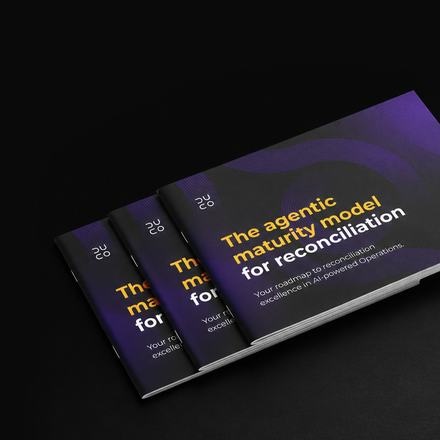
But how do you get there? The agentic maturity model for reconciliation gives you a framework to follow.
The five stages of agentic maturity for reconciliation
Let’s explore what reconciliation looks like at different stages of maturity on the journey towards agentic Operations. There are five: EUC 1.5, AI experimentation, Governed & empowered, Hybrid workforce, and - of course - Agentic Operations.
Together, they chart the journey from the first tentative steps into AI, taken inside existing point solutions, through to a fully agentic model. Along the way, firms build the governance and control framework that makes wider adoption safe, then the human-agent hybrid teams where people and technology each focus on what they do best.
The final stage, agentic Operations, is where agents have automated as much of the high-volume, low-value work as possible, and people review and approve their output centrally.
Let's look at each stage in more detail.
Stage 1: EUC 1.5
A large numberof recs are still carried out manually, using end-user computing solutions (EUCs), often on tools with some AI capability built in. For example, an analyst may be using Microsoft Copilot in Excel to build their macros faster. It’s more efficient and robust, but it doesn’t solve the real issue: a shadow IT solution is working around your change management policy. Governance is limited, the risk of error is high, and there's little auditability. Adding point AI workflow tools has, if anything, made Operations more complex.
Stage 2: AI experimentation
AI's potential is widely recognised, and pilots and use cases multiply. They're often driven by where AI can be applied rather than where it adds value. This is a natural step as firms work out the difference between hype and reality.
Stage 3: Governed & empowered
A clear governance framework lets teams across the organisation replace manual Ops work with AI-powered automation, built on machine learning and deterministic rules. Efficiency is up, risk is down, and teams focus on the exceptions that genuinely need their attention.
Stage 4: Hybrid workforce
Hybrid human-agent teams are established. Agents take on the heavy lifting of process setup, optimisation and exceptions investigation, though they're still largely confined to individual platforms. People log into the software to oversee the agents' work. Reconciliation is elevated from a last line of defence to an adaptive upstream control.
Stage 5: Agentic Operations
Digital employees connect to other agents across the organisation and access headless systems (that is, software without a user interface) on their own. Operations teams no longer log into reconciliation platforms. Instead, they review and approve proposed actions centrally, and focus on the value-adding work of efficiency and scale, while transparent, governed AI handles the bulk of reconciliation and exceptions management.
Start with where you are today
The key to climbing the maturity ladder is knowing which rung you're on. Once you can see where your reconciliation function sits, you can identify the next steps, detailed in the Agentic maturity model for reconciliation, that take you to greater efficiency, scale and control.
The blockers to agentic Operations, and how to clear them
No technology adoption is without its hurdles, and they can be sizable when the technology in question is reshaping the operating model and the nature of work itself. The good news is that none of them is insurmountable.
Here are four of the blockers firms are meeting, or soon will, on the way to agentic Operations, and how to clear each one.
Finding where AI actually adds value
The hype around AI hasn't made it any easier for Operations leaders to work out how to use it well. Everyone's excited about the technology, and plenty of firms are experimenting freely without seeing much value come back.
The way through is to start from the problems you need to solve, rather than hunting for places to bolt AI on. Get to know your biggest challenges first. You might even find the answer doesn't need AI at all, or at least not agentic AI, but something deterministic like machine learning.
This allows you to find the genuine opportunities where AI adds value that nothing else can.
Moving from pilot to production
Even with a promising use case, getting AI into production can be surprisingly hard. That's usually because the sanitised world of a pilot is built to model an idealised post-trade, one where every dataset is clean and consistent. Little wonder it struggles the moment it meets the real world, which is gloriously messy and complicated.
You can read insights from leaders at CIBC Mellon, HSBC and Celent on the challenge of moving AI beyond the pilot stage. Much of it comes back to one thing: governance.
Governance is both a blocker and an enabler, as we'll see next.
Getting governance right
There's a reason the right governance framework for agentic AI in post-trade has a whole stage of the maturity model to itself. Governance can accelerate AI adoption or hold it back, and the difference comes down to how you approach it, and how early: the sooner, the better.
Put your control framework in place early and your teams can point their energy at the AI use cases that are most effective and transparent.
Interestingly, the move from Stage 2 (AI experimentation) to Stage 3 (Governed & empowered) often brings a reduction in AI usage. That's a good thing, as it means you've got the guardrails in place to innovate safely where it truly matters.
The fear of being replaced
Resistance to change is one of the biggest reasons transformation projects fail, and fear of the unknown is only natural. Agentic AI can feel especially personal for people in Operations. Headlines about mass job losses, and some unhelpful comments from senior figures, have fed a perception that agentic Operations leaves no room for people.
The reality is very different. The more people understand the technology, the less power that fear holds. Getting hands on lets people see what AI can and can't do, and where the real capability gaps are that still call for human expertise and judgement. Operations leaders consistently tell us they see AI not as a replacement for people, but as a way to hand off the tedious manual work nobody wanted in the first place.
Begin your journey to agentic Operations
Agentic Operations is a destination you reach one stage at a time, and the first move is the simplest: work out where your firm sits today. Reconciliation is a great place to start, because it contains a lot of the messy situations where traditional automation technology fails, but AI excels.
The firms already moving aren't waiting for the technology to mature or the fear to fade. They're getting hands on, learning what agentic AI can and can't do, and building the operating model their teams deserve.
Want more best practices and strategies for bringing agentic Operations to life? Check out the latest insights on AI from CIBC Mellon, HSBC and Celent for the sell-side, or hear from CPPIB and Alpha FMC on agentic Operations for the buy-side.