

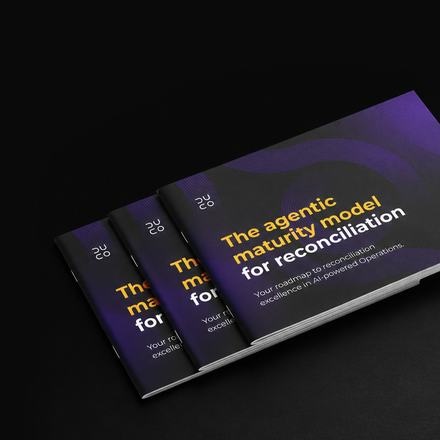


Reconciliation
Handle more
recs,
more
complexity
with
less
processing time
Trade volumes are increasing, processing windows are compressing, and budgets are staying flat. Capital markets firms need an agentic operating model that automates data controls to:
- Meet market and business demands
- Reduce operational risk
- Use agents to keep your teams focused on the decisions that matter
Proven with some of the world’s largest financial institutions since 2013.
Clients have seen:
$3-4m
savings per year
50%
AUM growth with no new headcount
91%
reduction in reconciliation build time with agentic workspace
80%
reduction in the number of reconciliations
Dynamic matching that delivers.
Duco’s dynamic matching engine just gets better match rates. User-set tolerances, roll-up rules, fuzzy matching and multi-pass processing filter out the noise of false breaks, cutting investigations, speeding up upstream fixes and improving data quality so you can automate with confidence.
A rule-based engine,
with agents around it.
When it comes to critical operational data, consistency, predictability and accuracy are non-negotiable. Rule-based processing ensures consistency. Agents deliver the speed. Your team makes the calls.

Rule-based capabilities you can trust
- Dynamic, repeatable matching with user-managed tolerances and starting checks/account proofing
- Rules logic: roll-ups, fuzzy matching and multi-pass processing
- Multi-recon view across 3 or more reconciliation processes
- Processing at scale: 1 billion transactions per day

Agentic AI capabilities with humans in the loop
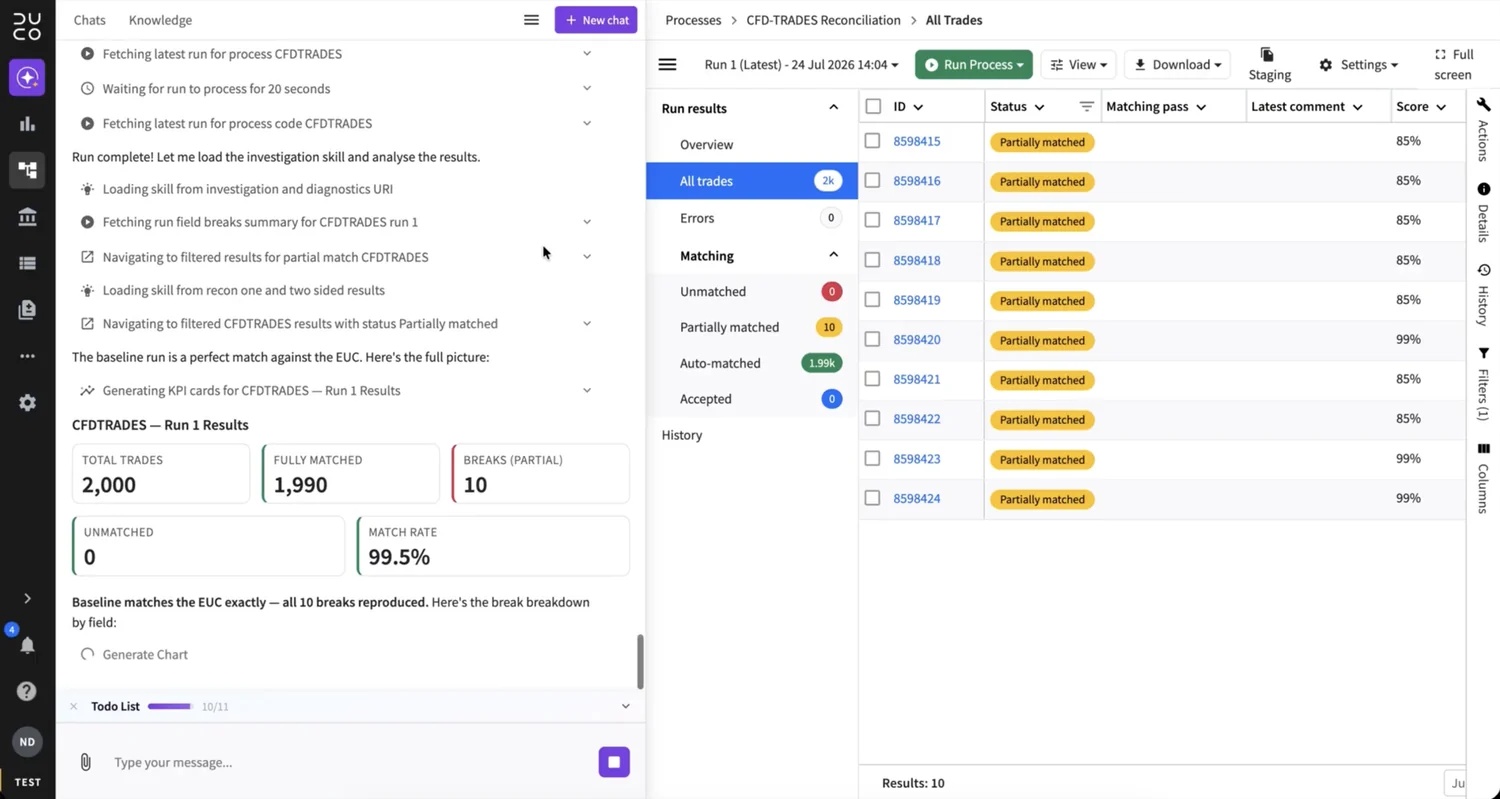
- Agentic reconciliation build: describe what you want, and agents identify the rule-based tools to use and build the process
- Monitor and optimise match rates
- Refine input logic with agent-suggested improvements
- Optimisation: agents review processes to find drift and propose fixes.
Do it all on one platform, with one set of controls, from preparation to reconciliation and exception management. Rules do the processing. Agents do the legwork. Your people make the calls.
- Data preparationView page
- You are hereReconciliation
- Exception managementView page
- Best-in-class matching
- Process governance & control
- Security & compliance
 Best-in-class matching
 Process governance & control
Reconciliation FAQs
There are some characteristics that all good reconciliation software should have, regardless of your particular use case or business setup. These observations come from our years of experience dealing with financial firms of all sizes across the globe. The following features are vital to ensure you get the most from your reconciliation platform:
- Flexible ingestion: Match rates are vital. A solid reconciliation tool should have fuzzy matching and rule-based tolerances to filter out false breaks due to formatting or rounding. It should also have strong controls around these rules to ensure auditability.
- Best-in-class matching: Match rates are vital. A solid reconciliation tool should have fuzzy matching and rule-based tolerances to filter out false breaks due to formatting or rounding.
- Ease of building and managing: Platforms where business users who know the data can build and modify processes will save time, money and headaches. Avoid systems that require massive change projects just to build or change a rec.
- Exception management capabilities: Ease of use is the name of the game here. No matter how good your match rates are, you’ll still have to manage exceptions. The ability to label, comment on, assign, and resolve exceptions from one screen is vital. Automated or rule-based exception management is even better.
- Reporting capabilities: The ability to feed data downstream and view status and results on a dashboard is key to oversight and identifying the trends that signal upstream problems.
- Total cost of ownership: Consider upgrade costs, maintenance costs, IT and project costs, and intangible or opportunity costs. A cloud-based solution, for example, will cost you significantly less than an on-premise deployment, while providing much greater scalability.
Duco enables you to have confidence in your data by checking its accuracy, flagging any discrepancies and providing a streamlined workflow for resolving breaks. The platform combines data preparation, normalisation, validation and reconciliation, giving you a transparent and auditable view of the end-to-end process lifecycle.
Beyond this, the Duco platform’s ability to focus on genuine reconciliation breaks, by removing the ‘white noise’ of false breaks and automating the resolution of routine exceptions, allows our customers to shift their focus upstream. They are able to fix data quality issues at source, permanently removing bad data downstream. This ensures that they can trust their data and removes the need for extensive and expensive manual intervention.
Implementing the Duco can be done in a matter of days without large IT projects. The platform is Software as a Service (SaaS) so is available to use almost immediately, with no installation needed. Then, depending on the complexity, you can build a reconciliation from scratch in a matter of hours.
More complicated reconciliations can take a few days or a few weeks, depending on your internal processes and requirements.
Duco can be completely self-service, but – for added speed – you can also take advantage of our professional services capabilities, where our reconciliation experts can help you build and deploy your reconciliations.
You can respond much quicker to changing business needs with a SaaS platform, enjoy significantly lower total cost of ownership and easily access the latest tools and capabilities. As a Duco customer you’ll benefit from continuous innovation, with new features and improvements rolled out seamlessly on a monthly basis.
It’s also easy to adjust your usage of the platform, scaling to meet new volume or use case requirements, or to serve different teams and geographies. Compare this to an on-premise deployment, where not only do you have the cost of hardware and maintenance, but also changes/upgrades require major and expensive IT projects.
Once the data is reconciled, you can use Data Platform to pull the data, breaks and workflow information into visualisation tools like PowerBI or Tableau, feed it into Excel or SQL databases, or push it to other internal systems or reports.
Duco stores several years’ worth of historical data so you can use it to spot trends and identify points of failure in processes. You can also export the data to upstream processes or downstream for other reporting purposes.
Yes! With Duco you can schedule data prep processes and reconciliations to run at specific times of the day, or when pre-defined levels of data have been received from counterparties or internal teams.
Absolutely. Contact us to discuss your reconciliation needs and schedule a demo.
Data reconciliation has many challenges, but two of the biggest are data quality and transparency and auditability.
Data quality You’re almost never reconciling data sets that are perfectly clean and aligned. You receive data from various sources with formatting differences – for example, one file denotes currency with a symbol, another with the three letter code, dates are in multiple formats, and frequently some data is missing. This requires a lot of work to get the data into shape before you can even think about reconciling it. That may be done with macros, manually, or with an expensive point solution.
Transparency/auditability If you’re reconciling data in spreadsheets or using manual interventions to get data in shape (as above), you introduce the opportunity for human error. As data is added and normalised manually, mistakes can happen, and they’re frequently not found until much later. It can be bad for your day-to-day operations, but even worse when you’ve got to deal with an audit.
With automation platforms like Duco, messy data is no problem. You can clean up your data in the platform, without separate solutions, quickly and easily. And every action you take is self-documented automatically in a PDF. So you – and regulators – can see exactly how the data was processed.
Many accounting tools provide reconciliation capabilities to enable you to compare your general ledger to bank statements, but they are frequently not robust enough to handle the various formats that come in without specific APIs. This means you spend time managing spreadsheets, and slowing down your processes. Which can be a problem, as reconciliations need to happen accurately and quickly for reporting and cash management purposes.
Duco can manage multiple data formats without the need for specific APIs. Data in PDFs, SWIFT formats, and excel or CSV files can be uploaded as is and normalised in the platform. And Duco’s best in class matching engine means you filter out the noise of false breaks, getting to the right data, faster.