


Buy-side leaders know that agentic AI can help them tackle their post-trade challenges. But they also know there are hurdles they have to cross first: governance, operating model structure, adoption.
Our webinar on the buy-side agentic AI playbook aimed to help Operations leaders in asset and wealth management to tackle these blockers. Two experts joined Duco Chief Client Officer James Maxfield to share their perspectives, strategies and learnings from the world of agentic AI in post-trade.
Chyavan Rees is a partner at Alpha FMC and is the lead for AI and Operations. Rees works with buy-side firms across the globe, helping leaders think about operating model strategy, technology and compliance.
He is also a contributor to our latest guide: a playbook for the buy-side on building agentic Operations, featuring the insights, learnings and research from Rees and his team.
Michael Leader is Managing Director and Head of Investment Operations at CPPIB, a global investment management organisation building a retirement foundation for over 22 million Canadians. Leader is well known on the conference circuit as a top industry voice on innovation.
Our webinar saw them discussing the biggest topics in post-trade in front of an audience of buy-side leaders. Here are the key takeaways of their conversation.
State of agentic AI adoption in post-trade operations
First, our panellists wanted to set the scene. Agentic AI is all over the news, and this widespread coverage makes it seem like the technology is ubiquitous across Operations. But is that really the case?
Rees said that there is certainly a perception among the asset managers that he and his team talk to that their peers are further ahead with AI adoption.
Alpha FMC wanted to test that hypothesis, so ran a survey across 75 asset managers and asset owners globally to find out if the perception was warranted. 91% of firms said that they had adopted, or were planning to adopt, agentic AI.
But beneath that headline, the “conclusion was quite damning”, Rees said. Only 43% of firms had already adopted AI within their operating model, and of those firms the most common use cases were ‘AI-assisted’ (i.e. tools like Microsoft Copilot) and enterprise large language models.
“What we're seeing is post-trade operations is behind investment functions,” Rees said. “It's behind client functions. It's behind broader industries and technology industries in AI adoption.”
But this doesn’t have to be the case, and Rees is optimistic that agentic AI’s potential will be realised in post-trade.
“We're really arriving at that moment where AI and agentic AI deployment can transform these functions as we go into the latter half of 2026 and beyond those relatively nascent use cases of enterprise LLMs and AI assistance.”
Leader agrees that there’s certainly a lot of experimentation happening among his peers when it comes to AI. But he wondered how many of those firms were truly AI-enabled.
“It's a small proportion that are moving into that space. Most are clustered, from what I've seen, around AI helping them to do things more efficiently. No one's really got to that point where an agent owns the full workflow, with human oversight being very limited or on an exception basis.”
It’s not just that AI adoption is very uneven by firm, Leader pointed out, but that levels of maturity can vary dramatically within a single firm.
“Reconciliation and exception management are well ahead because it's a very well-bounded process. It's high volume. Things that require judgment or any kind of cross-team negotiation - those are the areas where people are still just scratching the surface.”
Where AI is being used to good effect is on well-contained use cases, where data is high volume and the process can be controlled end-to-end.
So, the question, as Leader sees it, is not who has AI and who doesn’t, because “everybody does”. Instead what matters is who has the governance and data discipline to allow those agents to act. In most cases, it’s “just not caught up”.
Maxfield added that the governance is necessary not just to control AI innovation, but in fact to enable it. “Where people are more comfortable with the boundaries or the rules there seems to be more comfort around letting agents work there. Where the area's a bit grayer or there's a bit more judgment, that's where people are a bit more hands-off.”
Is it easier for buy-side firms to adopt agentic AI?
There are notable differences between the buy-side and sell-side communities. They require different operational processes, have different compliance needs, and have different regulatory considerations. Does this create a more favourable environment for agentic AI in one or the other, or do they both simply bring different challenges?
The buy-side is a spectrum, Rees explained, spanning from a firm like a small, single-geography equity manager with an AUM of $30bn to a large global hedge fund or asset manager with a 500-person technology function.
The levels of AI adoption vary greatly across this spectrum. But when it comes to the accelerator, Rees said, there is one clear similarity across all leading firms: governance.
“That perfect balance of governance, policy, executive buy-in, and leadership from the top, leaves autonomy for the day-to-day teams within the Operations functions to experiment, to deploy AI, to find use cases and to deploy them across their Operations function.”
“Having the governance that gives the autonomy at the bottom level is really what allows these organisations to move forward.”
Maxfield agreed. “Governance is seen as a blocker to doing things. Actually, if you think about it in the right way, it becomes a really powerful enabler if you can get it right.”
Leader noted that many buy-side firms have large in-house technology teams to rely on and their processes are often high volume and lower in complexity. This can make it easier for them to implement and scale agentic AI.
The buy-side deals with less volume, but has more complexity in terms of multiple currencies, multiple custodians, private markets, and so on. “It's a great area for [agentic] to help us, but it just makes it a bit tougher for us to kind of move things through,” Leader said.
“The blockers on both sides have their own nuances, but I think it's more just right now it feels like the use cases that are ripe for the agentic side are more on the bank side, and asset managers are starting to catch up.”
The biggest blockers to agentic AI maturity for buy-side firms
So, many firms are talking about agentic AI. The potential is recognised and the desire is there. There is often a mandate from senior leadership. But, as Alpha FMC’s research has shown, that desire isn’t translating into progress.
Why is that? For Leader, there are three key challenges that are slowing firms’ progress towards agentic maturity.
The first is to do with trust. “It's not about the technology. It's about trust. The tools are there. They work. They can do what you need it to do.”
Where the issue lies is that leadership don’t trust the technology enough to “remove the heavy human element”. For instance, letting agentic AI do the heavy lifting on repetitive, manual processes and redirecting human efforts to more fruitful tasks.
This, Leader said, comes back to governance and audit trails. It’s not about what the model can do, it’s about knowing that it’s doing it safely, transparently and within necessary guardrails. “Until they really truly trust it, and can live with it, you're going to find that adoption and maturity just won't get there.”
The second blocker Leader identified is around process debt.
“Pointing AI at something broken doesn't fix the fact that it's broken.”
He explained that firms are sometimes approaching this the wrong way round. Their focus should be on understanding the process, simplifying it and standardising it. Then you can layer technology on top.
It’s not about getting the perfect process, though - in fact, that’s one of the blockers we identified in our whitepaper with Alpha FMC - because “that's where the technology today can help you”.
“But if it's busted and you point [AI] at it, that's not going to work. And it's where people end up doing a lot of rework because they think the technology can solve the problem.”
The third issue Leader sees is the “earned skepticism”, which Maxfield mentioned before, of an industry that has seen large transformation initiatives that have struggled to succeed.
Instead of finding “narrow, credible wins to move things along”, many firms attempt to solve huge problems at a time, and it’s difficult for teams to get their heads around.
Rees added that a big blocker is that firms seem to be waiting for a “lightbulb moment” where the savings and efficiency gained from agentic AI become clear. The attitude, he suggested, should be the complete opposite.
“What's the problem we actually want to solve in our post-trade operations? Is it that at month-end we have a really big capacity challenge in one of our teams? Is it a quarter-end problem? Is it around private assets? Is it operational risk within an area of our business?"
“Rather than waiting for the light bulb moment, go, ‘Actually, what is the problem that we're looking to solve, and what is the objective, and then where do we deploy?’”
What makes this approach so practical is that it addresses the problem, not the desire to use a technology. In fact, Rees noted, the conclusion of this particular thought process may even be that the solution to a problem isn’t AI, but other forms of automation, such as deterministic tools.
What keeps post-trade leaders up at night
We also asked our audience what they saw as the biggest issue when it comes to implementing agentic AI.
The need for an operating model restructure to get the best out of the technology was the clear winner, with 40% of the votes, followed by data quality, which was chosen by 30% of respondents.
“Part of this journey for every organisation is being deeply sensitive to the operating model transformation and the role people play in this going forward,” said Maxfield.
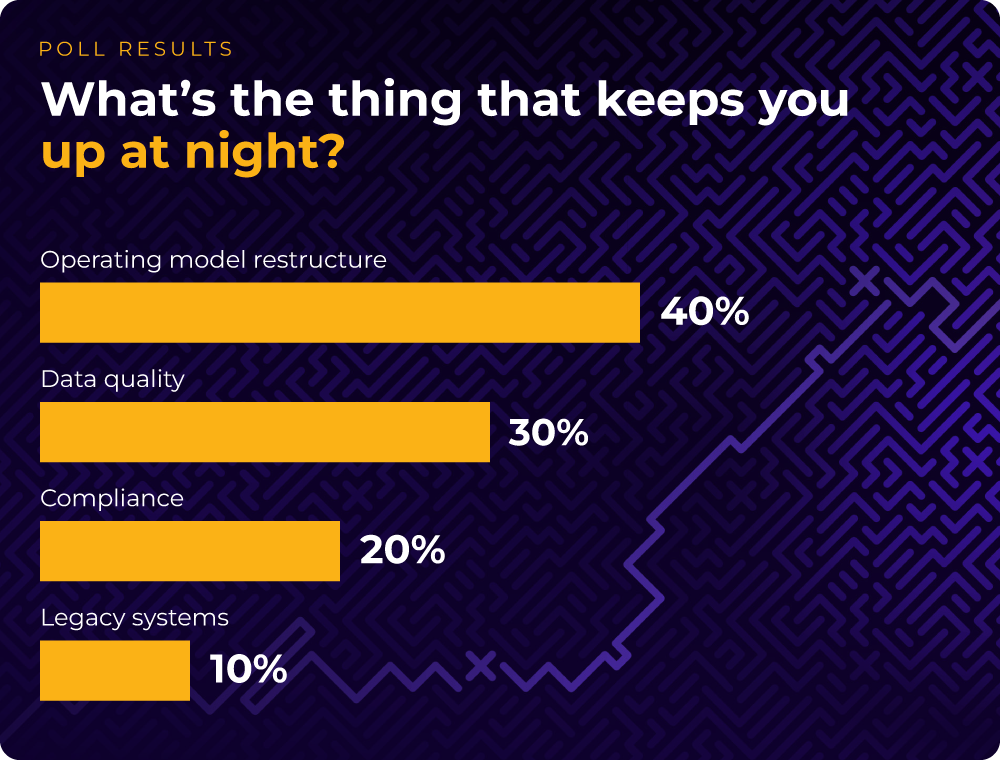
Leader wasn’t surprised that operating model topped the list of concerns, but pointed out that they are all interconnected.
“If you've got weak data and legacy systems, they can be root causes to compliance and workforce anxiety. So I don't think they're separate in any way.”
He also acknowledged one of the main concerns around AI-driven operating model change: the impact it could have on people. But he stressed the importance of human accountability and judgement, which AI can’t replace.
“It's about enriching the people that are here, not replacing the people that are here. What [AI] can do is it can remove that repetitive volume, mundane stuff that nobody likes doing.”
This is a common theme that runs through our many conversations on agentic AI over the past few months: people’s jobs aren’t going away, they’re just changing.
“This is about doing more with the same,” Rees agreed.
He highlighted the growing complexity of the asset management industry, especially with product expansion into private assets and tokenised ETFs. “People are moving into different geographies, different asset classes, different markets.”
Under the current paradigm, supporting these growth opportunities would require massive headcount increases - and a lot more tedious manual work for Ops. That’s what agentic AI is able to tackle.
“AI enables you to grow that part of the business without exponentially adding headcount like you were doing in past years. Doing more with the same, focusing people on high-value tasks, focusing people on operational change, the exciting work and actually making Operations roles and what people are doing day-to-day really attractive - that is the benefit that agentic AI can bring to these functions.”
The five step playbook for agentic AI in post-trade
Next it was time for Maxfield to take our audience through the five-step playbook we have produced in partnership with Alpha FMC. It’s aimed at giving buy-side post-trade leaders a concrete set of guidelines they can use to implement agentic AI in their Operations.
He outlined the steps:
- Start with the problem, not the technology
- Use agents for the tasks that need them
- Give your agents a mission
- Interrogate your AI partners on their governance approach
- Ringfence your data
For Leader, the first step is the one that strikes him as most important.
“Far too many times, people come in with really sexy technology and they feel like that's going to solve the problem, but they don't actually know the problem they're solving,” he explained.
“It's key that you need to be able to find that problem in concrete terms, whatever it is; control gap, concentration risk, capacity constraint. But you need to be able to name it precisely enough that you know if you'd actually solved it.”
He suggests approaching this by asking two questions: 1) What does success look like, and 2) How would you know if it failed?
“If you can't define and cleanly answer those, you're not ready to start, no matter how promising or cool the technology looks. You've gotta be able to define that problem and answer those two questions.”
Under this approach, he said, a proof of concept is a real gate, “not just a formality”. It is where you prove that there is value in the deployment before you attempt to scale it.
“When you look at a technology-first initiative, they tend to get funded pretty easily. But they get cancelled really easily, too.” It’s difficult to clearly define the problem before you start, Leader said, but once everyone is aligned on it, “it’s really hard to kill that project”.
Rees agreed that the success criteria is an important point.
“One of the most common questions that we get asked by our clients is, ‘How do you measure ROI on AI?’ and actually, that's not a one-size-fits-all answer.”
Once you have those measurement criteria, he said, it becomes easier to convince the business to scale AI from pilot to production.
Starting with the problem is also a good way of ensuring that you then identify the right technology for the job, rather than using agentic AI simply because it’s the most exciting current innovation.
“We're very embedded in reconciliations,” Maxfield said. “We do this a lot. But actually you wouldn't use agents for that. You've got a very smart deterministic engine that's really good at matching complex data sets.”
As well as deterministic tools, many of the AI use cases already creating value are using other forms of AI, such as generative AI, rather than agents. Typically, agents add value around the edges, for example:
- Interpreting exceptions
- Navigating policies and procedures
- Prioritising issues for resolution
- Coordinating handoffs between teams
The third point - give your agents a mission - ties into this. “What's the purpose, what's their role in that operating model?” Maxfield asked. Agentic AI works best when it is deployed with a mission, not on a platform-by-platform basis. This means giving it a defined outcome, clear boundaries, points where it should escalate, and a human owner.
The fourth step in the playbook is vital, given the concerns around the impact of implementing AI in post-trade: interrogating your vendor over their governance approach.
“We spend a lot of time talking to clients and prospects around governance, transparency, auditability,” Maxfield explained. “To my earlier point, it's quite easy to spin up a pilot with an agent to get them to do anything.”
“But actually to better productionise that with auditability and all the important things [is a] very different thing. There's a real balancing act for organisations as they go through this build-versus-buy thought process around how to think about that governance piece.”
And this level of control isn’t just something you want applied to the way the platform can or can’t act - you want the same level of confidence in how any platform is using your data. It’s highly sensitive, and you don’t want it being used to train the vendor’s models, which other customers may have access to.
Once you have these assurances over your data, however, agentic AI becomes a powerful tool for improving its quality.
“Data is always going to be important,” Maxfield explained.
“One of the things we're finding is agentic AI is good at solving bad data. There's some interesting discussions now around can you use agentic AI to give you a better data set?”
Rees agreed, noting that “often all AI conversations row back to data”.
“We hosted 11 heads of client reporting at our office last week. Everyone said, ‘Actually, the biggest use case at the moment that we've got for AI is improving our data quality.’”
It’s important to note that focus on using AI to fix data quality, he said, because there’s a misconception that you have to have perfect data before you can use agentic AI. This is something we address in our report.
How to get started with agentic AI
How should firms begin their agentic AI journey, Maxfield asked. Do organisations need a dedicated team; do firms need to hire in AI specialists; it is as simple as just showing people Claude and telling them to get on with it?
In particular, how do firms get started with AI without it becoming one of those massive transformation projects Leader referred to earlier - the kind that stall quickly and put people off?
There are two key elements, according to Rees. The first is cultural shift and expectations, which involves building a culture where employees are encouraged to use AI in their day-to-day roles. This is important, because research shows that user resistance to new technology, or a lack of engagement with it, is a key reason why transformation projects often fail.
This culture has to come from the top, Rees said. “I was speaking to one of our clients the other day who had the COO sat in a hackathon at lunchtime with a bunch of the other employees from the Operations function. Demonstrating that leadership from the top - a culture of safe experimentation - is number one.”
“We need leaders, we need COOs, we need execs in the room using AI and encouraging employees.”
Leader agreed, sharing that this is the approach taken at CPPIB, where AI experimentation happens at all levels. “It's not just technologists or junior people, it's everybody - myself included. I've done a five-day sprint vibe coding and building skills.”
The second key factor, Rees said, is finding people within the function who can be AI champions. “These don't need to be AI experts, data scientists, or have been building agentic workflows for the past three years. They need to be people who feel passionate about sharing their learnings with their colleagues; people that come in after the weekend and show their colleagues what they've built using Claude for their personal life, or an agent they've built to plan their holiday.”
For Leader, experimentation is key.
“What's really been a success point is allowing people to experiment on their own with use cases for short periods of time to see if they can solve that problem. It is not just about trying to solve the problems, it's about learning the tool. What is it capable of doing?”
Experimentation is the best way to learn, he said. “There’s no one single course that’s going to teach you. The best way to do it is to play with the tools.”
“Find a single problem that keeps you up at night, whether it's professional or personal, and then try and fix it and experiment.”
One way to incentivise this kind of experimentation, he said, is to create ‘FOMO’ - fear of missing out. “We did some work in pockets of areas through hackathons, create-athons, whatever you want to call it. Then start to let other people hear about it. And then that's just ballooned. We've got just over 2,000 employees, and our adoption rate of AI use is in the low to mid 90s in terms of people that are using it on a regular basis.”
Conclusion
It was evident listening to Rees and Leader that we shouldn't be viewing agentic AI as anything other than a new innovation, Maxfield said.
“It's technology. It's powerful technology, but we shouldn't be forgetting about all the key ingredients around what transformation looks like. Technology enables transformation; it's not the transformation itself.”
“The art of the possible is quite significant. The industry is looking at this as an iPhone moment. Understanding the role that people will play in the workforce of the future is going to be super critical to the success of the transformation journey.”
Successful adoption relies on several key factors:
- A solid understanding of, and alignment on, the problem you are trying to solve
- A focus on the problems that agentic AI is uniquely positioned to solve
- A clear plan for empowering employees to experiment, learn and become comfortable with agentic AI
- Strong leadership to drive adoption
Get these things right, and you are well on your way to realising the potential of agentic AI for post-trade. Speak to us to accelerate your journey.