


What hasn’t already been said about agentic AI? Quite a lot, once you get beyond the superlatives. Financial services leaders are tired of hype; they want concrete, actionable information on how to use AI to add value.
Firms want to find the truth inside the hyperbole so that they can reconcile their leadership’s AI-adoption drive with the reality of a complex, fragmented operating environment.
Our latest webinar set out to help leaders like you to achieve all of that and more. We brought together experts who are currently living the agentic AI transformation. This wasn’t about philosophy or bragging - it was about sharing real observations, lessons from the trenches, and best practices that are shaping what firms are actually doing with AI right now.
Exploring how to move AI to something controlled, trusted, and running at scale were:
- Jeremy Hulme, VP, Operational Excellence and Transformation, CIBC Mellon
- Daniel Wright, MD, Head of Strategy & Change Delivery, Markets & Securities Services Operations, HSBC
- Janey Speed, Research Analyst, Capital Markets Technology, Celent
Our host, Duco’s James Maxfield, set the scene:
"For some people, this is the iPhone moment for post-trade: the unveiling of technology capable of automating the most sophisticated, knowledge-rich processes, typically the domain of the experienced subject matter expert. For others, it brings eye-rolling and war stories from the days of early macros, the RPA [Robotic Process Automation] revolution, and the early days of machine learning."
Here are the key takeaways from our panel’s discussion. Together, they form a guide you can use on your own journey towards agentic Operations. Click below to jump to a specific section, or keep reading to get the full insights.
Why post-trade is the ideal target for agentic Operations
Identify the key blockers
Identify where agentic AI adds the most value
Build an ROI case that goes beyond headcount
Make the build-versus-buy call through a governance lens
Treat governance as an agentic AI enabler, not a blocker
Cross the gap from pilot to production
Keep humans at the centre
Measure success by value, not usage
Walking the path to agentic Operations
Why post-trade is the ideal target for agentic Operations
The days of innovation gaps between the front, middle and back offices are coming to an end. "Historically, the front office has experienced the largest proportion of tech spend, with the middle and back office often expected to make do with older systems and heavily manual workflows,” Speed explained. “But that's changing, and it's changing quickly."
Several forces are converging at once. "You've got the global shift to T+1, the realities of extended or 24-hour trading, coupled with the rise of digital assets. We've got the growth of private markets, as well as increased demand for seamless front-to-back operating models."
There is one topic that underpins it all.
"Across the majority of our post-trade research, there's one theme that keeps coming up again and again, and that is data. So not just having data, but having data that you can truly trust. Data quality, lineage, delivery frequency, and now data standardisation are becoming the foundation for this modern post-trade world."
This makes post-trade a prime environment for an agentic overhaul. However, there's a healthy dose of realism creeping into the conversation around AI. "Many industry players are now becoming a bit more sceptical of the hype," Speed noted. "They're asking more pragmatic questions of what the real-world use cases are, and what the business rationale is for putting AI into day-to-day operations."
That scepticism is both welcome and hasn't dampened the trajectory. Celent's latest research found that 52% of respondents expect to have an agentic solution in production by the end of 2026. "I wouldn't necessarily say that's overly optimistic," Speed said. “The technology is here, and it is now being rolled out."
Stats around agentic AI adoption should be viewed through a critical lens, however. There is still a lot of confusion around AI and the different types available. "Some organisations are maybe using ChatGPT at best," Maxfield observed. "So what they think is agentic technology is actually really just deployment of a large language model."
Knowing the difference is step one, because choosing the right tool for the job is essential for success.
Identify the key blockers
We asked our audience of post-trade leaders what they thought would be the biggest blocker in their journey towards agentic Operations. Governance was the winner, chosen by nearly half of all respondents. This won’t come as a surprise to anyone following our coverage of the AI conversation. Governance dominated the debate at SIFMA Ops recently, for instance.
The split in how firms are tackling this problem is telling. "Some are quite simplistic: 'Let's start with what the humans do and then build up from there,'" Maxfield said. "Others are trying to go top-down, waiting for some regulatory guidance, which I'm not certain is forthcoming."
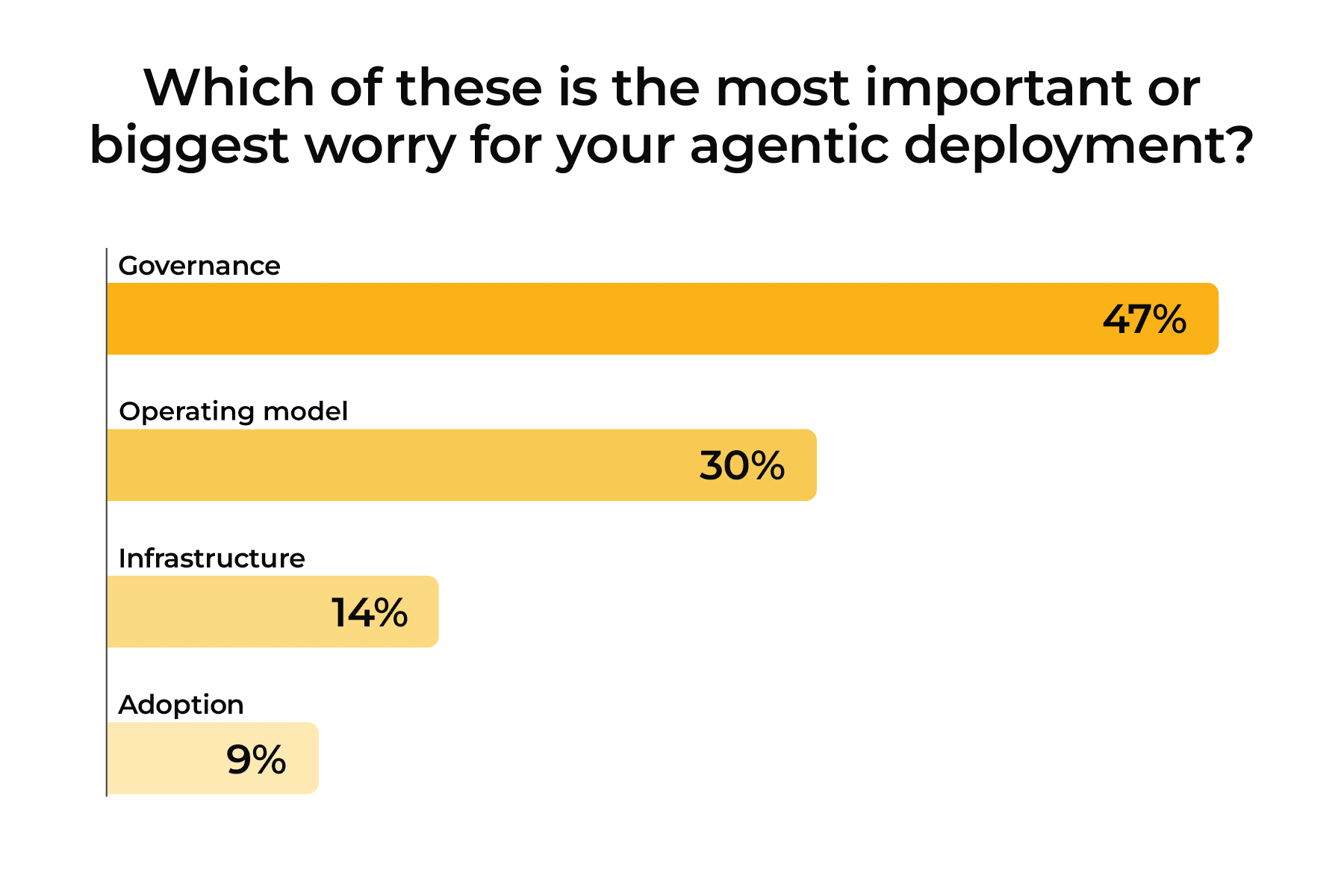
Operating model was the second most common area of concern, with a 30% share of the votes. Automation efforts up until now have focussed on accelerating the speed at which Operations workers can perform the same tasks they always have. Agentic AI, however, will fundamentally change what tasks they perform.
That has big implications for your operating model.
Infrastructure took just 14% of the votes - in other words, technology is not the focus. This is refreshing, because so many transformations focus almost entirely on the technology, forgetting the people it impacts. Which may be why 9% of our audience were most worried about adoption.
So, governance continues to overshadow the AI conversation. But it doesn’t have to be the blocker everyone thinks it is, as our panellists later discussed. We’ll get to that soon, but your next step to agentic Operations is to choose your deployments carefully.
Identify where agentic AI adds the most value
Celent’s research shows that leaders across the industry recognise the value of AI in post-trade. "Post-trade is the second-greatest area for agentic AI investment," Speed said. "38% of our respondents said it was the area that would benefit most from AI augmentation."
She shared three clusters of use cases where the value concentrates:
- Reconciliation, including process build and optimisation, auto-matching and predictive matching
- Exception management, including intelligent and automated exception workflows, plus root cause analysis and remediation with recommendations
- Corporate actions, including end-to-end voluntary action automation, and the analysis of custodian and issuer feeds to identify and record key event details, as well as election monitoring
The discipline, Speed argued, is in choosing between them deliberately. "Financial institutions should weigh up the ROI of these use cases against the feasibility of them. Is this a strategic win that will require a longer gestational period but a larger long-term payback? Or is this a quick win to boost the efficiency of an analyst?"
Maxfield drew a parallel with the last automation wave. "One of the observations from 10 years ago, when RPA became a thing, was that you had organisations buying licences on a large scale, sending them out and telling people to automate, which didn't really end well."
You need to be deliberate about picking the right places to deploy agentic AI if you want to unlock its true value. For Hulme, the distinction that matters most is where the AI actually lives.
"There's a real big difference between AI being used locally to help people's jobs be easier, and AI that's actually embedded as part of an operational workflow."
Both have value, but only one of them moves the operating model. And the embedded version is exactly where the early traction is appearing. "It's in the structured, high-volume processes [Speed] was talking about," Hulme said. "Reconciliation, exception management, the collation and preparation of data, where the workflows are well-defined, where you have measurable outcomes, and where you can apply the right level of governance and control."
But, while some firms are seeing promising results in the proof of concept stage, only a subset are "moving from experimentation to something truly productionalised, running at scale, with clear ownership and accountability," Hulme said.
“But that's where the real value is."
Wright said that the strongest use cases are where teams spend their time gathering, transforming and validating information and resolving exceptions. "So much of the opportunity appears in what I'd call the operational plumbing," he said.
"The value starts where the work is repetitive, normally exception-heavy, and honestly, where sometimes things are just a bit soul-destroying."
He also offered some insights into how not to look for use cases.
"I try to encourage people not to ask, 'Where can we add AI?' The better question is, what problem does AI uniquely solve? If there's a deterministic tool or a simple workflow you can put in place instead, an AI solution can often be overkill."
Get that wrong, and the cost shows up fast. "Otherwise," Wright warned, "you're going to find yourself going on what I'd call a very expensive side quest." Use AI selectively, where it genuinely takes friction out of the process, and you avoid spending heavily to solve a problem a simpler tool would have handled.
Together, Speed, Hulme and Wright gave plenty of ways to approach the quest for agentic candidates.
Build an ROI case that goes beyond headcount
The next step after finding the right use case for agentic AI is to justify it. Celent’s research identifies four drivers of return. They're worth holding in view because they pull the conversation away from a single, reductive metric.
"The first is revenue growth and alpha uplift,” Speed said. “The second is agility and speed. Third, operational resilience. And fourth, organisational differentiation." Across all of them, she added, "firms are moving beyond these interesting first-stage use cases and on to use cases that have quantifiable benefits."
Wright was emphatic about the metric to avoid. "It's not helpful to reduce the conversation down to how many roles are going to disappear,” he said. “I'd discourage anyone from measuring the return simply in labour saved."
"If you reduce the conversation down to a headcount, you miss most of the value, and you probably make people a lot more defensive than you want them to be about coming up with new ideas. The better ROI question is not how many jobs went away. It's how much better, faster and safer did the work become?"
He offered a more ambitious way to think about the upside. "You count these projects and people say, 'That's a two or three-year project.' Now that could be a six-month or one-year project. Imagine how many more of these things we can get done. I want to get twice or three times as much done with the people I have."
Put simply, the opportunity isn't to do the same work with fewer people; it's to do far more with the people you already have.
Make the build-versus-buy call through a governance lens
Many firms are debating whether outsourcing their AI capabilities is better than building internally. There are lots of factors to consider, such as technical expertise and speed of innovation. For Speed, the single biggest is now governance.
"Governance, risk and compliance is now one of the biggest forces shaping the build-versus-buy decision for agentic AI. It's not just an IT decision anymore. It's very much enterprise-wide."
Three considerations sit underneath that, and each can tilt the decision. The first is liability. "Even with third-party agents, regulatory accountability typically remains with the firm," Speed warned. "So if you're partnering with a vendor: can they provide full audit trails? Can they provide historical data? Can they offer change control?"
The second is data sovereignty. "If an agent is operating on sensitive client data or proprietary trading logic, firms may lean more towards a build approach, so they have tighter, controlled environments."
The third is auditability and explainability. "Financial institutions need a defensible record of what the agent has done. Why did it do it? What data did it use? And where have humans intervened?"
The common thread is sequencing. "The firms we've seen progressing the fastest have designed strong governance frameworks into the solution, not bolted it on later," Speed said. And whichever route you take, one principle is non-negotiable:
"Human oversight isn't an optional add-on. It's very much a necessity."
And while we’re on the topic of governance…
Treat governance as an agentic AI enabler, not a blocker
Firms are right to be cautious about agentic AI. “If we're introducing something into our operating model that can make decisions or take actions, in a regulated environment, it 100% should be scrutinised," Hulme said.
But at the same time, he added, that caution is being misdirected. It’s focussing on the technology itself, rather than how it’s being implemented. Done properly, he argued, agentic capability can be a step up in control. "Agentic capability can be more controlled and more auditable when it's embedded within an operational workflow. Implicitly, that means you've got the right governance, the right controls, the right traceability."
He also pushed back on the idea that standing still is the safe option.
"There are almost two extremes. You're going hell for leather to implement agentic AI, but you haven't got the governance or the controls. You should be very afraid in that scenario. But equally, there's higher risk if you continue to rely on processes that are already difficult to scale, using fragmented manual workflows and doing things the way they've been done for the last 20 years."
Wright suggested that firms address the governance issues around agentic AI by building in the open. "It should push us more towards a glass box and less of a black box,” he said. “We should be building these things so they're transparent about the decision logic going in, with clear, traceable, audit-ready documentation.”
“Autonomy without those clear boundaries is not my definition of innovation. That's a control failure just waiting to happen."
Rather than a blocker, Hulme emphasised that governance can be an AI accelerator - providing you focus on it at the right time.
"If you think about governance late, you're going to have a hard time. But if you think about it early and get it right, this is a massive enabler. Clear guardrails are a good thing. I don't want people to think governance is a blocker. Do it right, and it's an enabler."
Maxfield agreed, and suggested that what firms should aim for is ‘Goldilocks governance; not too little, not too much.’ And he dispelled a common hope along the way. "There's a misconception that the regulators will provide a playbook people can just tick off. In reality, the responsibility is on the firm to comply."
Cross the gap from pilot to production
So, you’ve carefully picked your use case, built a strong business case, decided whether to in-house or outsource it and figured out your governance framework. How do you take a promising set of results in the proof of concept stage and operationalise them?
For Hulme, it comes back to the distinction between experimentation and production. "Local AI usage, helping individuals work faster, is fantastic. But moving into production, particularly in a regulated industry, the bar is much higher. It's no longer just 'does it work?' It's 'is it controlled? Is it auditable? Is it repeatable? Can we stand behind this when we have a conversation with risk, audit, controls, or the regulator?'"
The data problem is the one that bites first. "When people do POCs, they tend to cherry-pick the things that work," Hulme said. "Once you move beyond the POC, you're dealing with real-world data quality, which is often much more complex than expected." Then there's the question almost everyone forgets to ask up front. "It's the cost of ownership. Who owns this once it's live? Who's responsible for managing it, tuning it, monitoring it, and changing it?"
His conclusion reframes the whole challenge. "It isn't really a technology gap. It's more of an operational and governance gap that needs to be thought about sooner rather than later."
Wright agreed, adding:
"Pilots fail in production because the hard part is not getting a model to do something clever once. It's that industrialisation. It's getting it to do something dependable thousands of times."
He recalled someone saying that "a pilot happens in perfect weather. Production happens in the rain.” You need to prepare for the rain, or you’ll get wet. And no amount of sophistication rescues a weak foundation.
"The idea that you can sprinkle magic AI pixie dust on garbage data and expect gold to come out the other side clearly isn't true. You end up with expensive garbage. AI in that instance just helps you to be wrong faster."
Indeed, as Maxfield expanded, “an agent just makes a bad process faster.”
Which brings the conversation back to one thing. "It really does come down to data," Speed said. "Agents are only as trustworthy as the data and the knowledge they're operating on."
That's why the move to modern infrastructure matters so much.
"We're seeing a shift towards cloud adoption and modern data infrastructures. This is enabling firms to access the full range of AI capabilities in a much more scalable way."
But infrastructure alone won't carry it. "It's not just a technical story, it's an organisational one," Speed said. The most effective programmes she's seen share a shape: a centre of excellence, access to skilled talent, and multidisciplinary teams with Technology, Risk, Compliance and Operations all in the room together.
And then there’s the area the poll ranked lowest but the panel rated highly: adoption. "Adoption is a hidden hurdle," Speed said. "If you don't have end users integrating these agents into their day-to-day work, the productivity gains aren't going to materialise. Firms should focus on embedding these tools into existing workflows, where the work actually happens."
Keep humans at the centre
Getting people to buy into your agentic Operations vision is vital to ever realising it. "Organisational buy-in is now a non-negotiable,” Speed said. “Agentic AI needs commitment from decision-makers, sustained budget, and visible champions who can drive enterprise-wide adoption. These initiatives can't succeed in a silo."
It goes all the way down to end users, who are likely feeling threatened by AI. Wright once again reasserted that the value of agentic AI doesn’t come from headcount reduction:
"AI should be a force multiplier rather than a replacement engine: helping teams be faster, deliver more, and get to higher-value work. It shouldn't make people less important. It should make human expertise more valuable, if we get it right."
It’s a positive message, and one that can help drive adoption, Maxfield said. "When we start thinking about people buying in, they're clearly much more likely to do that in a safe space, where the automation is not a threat to their role and is much more seen as additive."
Hulme agreed, pointing to where the value actually surfaces. "Operational change doesn't usually show up as direct cost removal. It's things like better efficiency, reduced rework, faster turnaround, and better controls."
Measure success by value, not usage
Getting agentic AI into production is a huge achievement, but now you need to measure the success of the project. There is still confusion on how to best do this. For Hulme, it comes down to the value created.
"It's easy to deploy a capability, or even get people using it, but that doesn't mean you're realising the value," he said.
"Real adoption and real value is when you see measurable impact across a few key dimensions: reduction in effort or manual touchpoints, faster time to resolution, better controls and traceability, or reduced friction. It's less about how many use cases you have, and more about whether those use cases are delivering sustained, real, measurable outcomes as part of the operating model."
Wright offered the simplest test of the lot, and it's one any executive can apply tomorrow.
"If you turn the tool off, would the team or the customer complain? If the answer is yes, you're probably creating something that's got value. If the answer is no, you might have done something interesting but not necessarily valuable to the business."
Walking the path to agentic Operations
Our panel kept returning to the same handful of truths throughout the discussion. Pulled together, they form a practical sequence for any firm setting out, as explored above.
Start with the problem. Focus on the issues you are trying to solve, rather than areas where AI can be bolted on.
Build the case on value, not labour saved. The better question is how much better, faster and safer the work becomes, and how many more projects you can take on with the team you already have.
Design governance in from the start. The firms moving fastest have done exactly this, treating clear guardrails as the thing that lets them go faster rather than the thing holding them back.
Respect the gap between a pilot and production. Doing something clever once is easy. Doing it dependably, thousands of times, on real-world data, under proper oversight, is the work that counts.
Bring your people with you. Frame AI as a force multiplier, create a safe space to experiment, and watch the value, not the usage.
As Maxfield reflected in closing, the constraint has shifted. "The technology's evolving so fast that the impossible is now possible. It's now a choice around governance, process orchestration, and how you embed things into your organisation. The barriers to innovation have dramatically dropped in the last 12 to 18 months."
Opportunity is calling. And now you have the guidebook to seizing it.
Want to get every last invaluable insight from our panel? Watch the webinar on-demand here.