



Exception management
Change the shape
of your day.
- Clear false and simple breaks before your day starts.
- Bring exceptions from multiple sources together in one place.
- Investigation focuses on the complex breaks that need it.
- Patterns become permanent fixes.
Thousands of
exceptions.
Where
should you focus?
Duco’s match rates keep exceptions low, eliminating false-break noise and surfacing only the breaks that need your team’s attention.
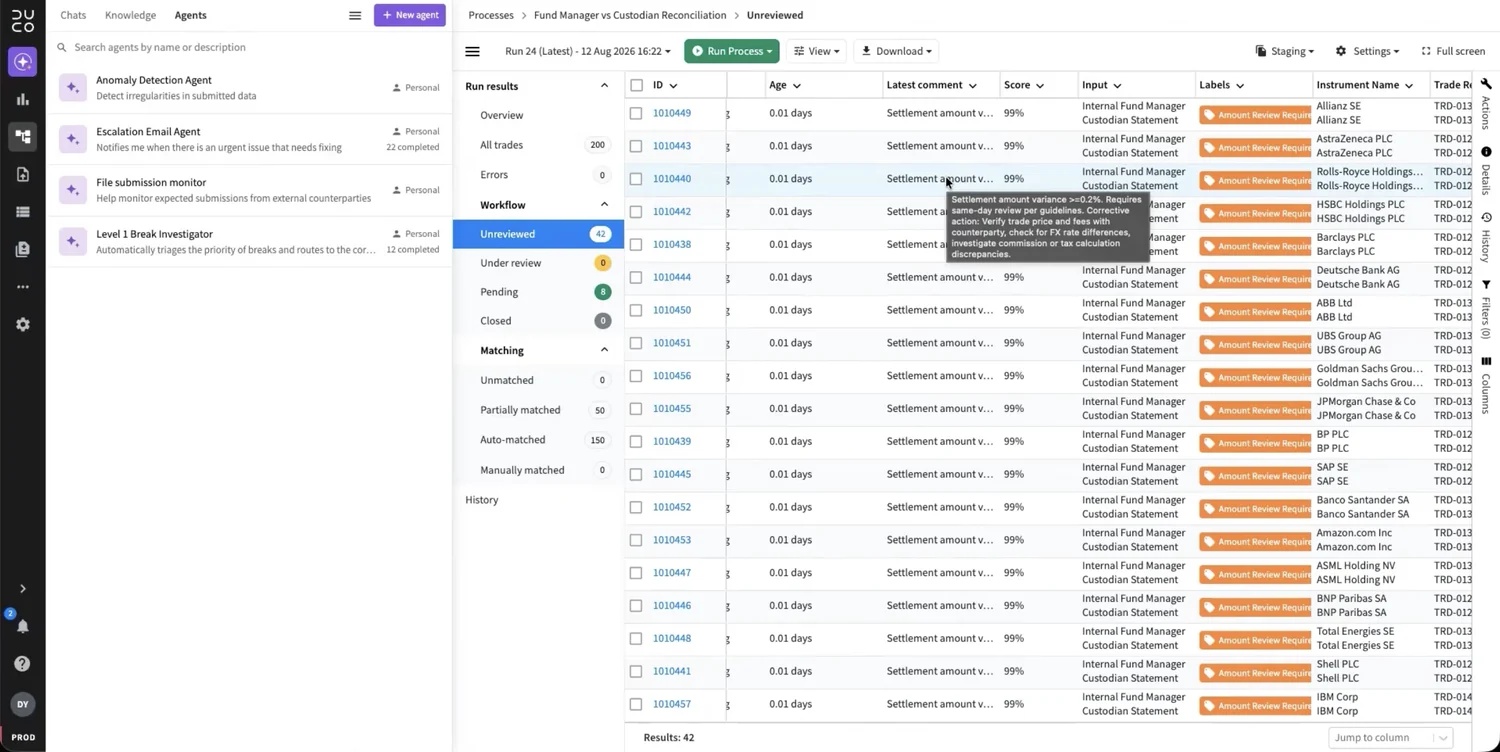
But even with great match rates, you’ll still have thousands of breaks. They’re true breaks, and most are easily solvable. Late trades, late data feeds, stale pricing data. Not to mention exceptions from other sources: settlement systems, other reconciliation platforms… But your team has to clear them before they can get to the complex breaks that need them.
Whatever the complexity, breaks need to be managed consistently: auditable, transparent decisions, automated processing, and root cause analysis that identifies recurring errors to be fixed at source.
Rules to define
exceptions.
Reasoning
to determine
action.
Deciding what counts as an exception, who owns it and when it escalates should be governed and consistent. Those are rules.
Taking action on them, working out why a break happened, means reading across data, history and context. That’s reasoning work, and it’s where agents help most.

The rules: govern, route and evidence
- Exception management view. One screen for workflow, ownership, ageing and audit.
- Workflow rules driving exception definition and handling procedures.
- Fixed labels and categories, so classification stays consistent across teams.
- Statuses, auto-close and carryover, so recurring items age correctly.

The agents: explain, summarise and act
- Root cause analysis, reading across data and history to explain the break.
- Exception summaries, so an investigator starts with context, not a blank screen.
- Noise handling with human validation, so known benign patterns stop consuming attention.
- Action on defined break types within their permissions, and upstream signalling of repeat patterns.
Five steps
from break to fix

01.
Detect
Tolerances, roll-ups and fuzzy logic resolve what should never have been a break.
Rules

02.
Filter
Agents handle known-benign patterns with human validation, so noise doesn’t reach a queue.
Agents · validated

03.
Route
Workflow rules label, categorise and assign whatever remains.
Rules

04.
Investigate
Agents identify a root cause and propose action. Your team confirms.
Agents · human decides

05.
Feed back
Repeat patterns surface with suggested upstream fixes.
Root cause
Do it all on one platform, with one set of controls, from preparation to reconciliation and exception management. Rules do the processing. Agents do the legwork. Your people make the calls.
- Data preparationView page
- ReconciliationView page
- You are hereException management
- Best-in-class matching
- Process governance & control
- Security & compliance
 Best-in-class matching
 Process governance & control