

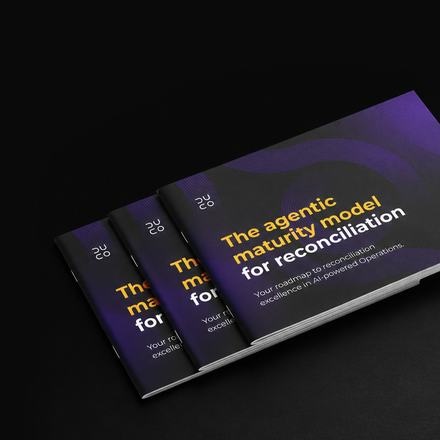

The agentic
maturity model
for reconciliation
Download your roadmap to reconciliation excellence and benchmark your firm on the journey to agentic Operations.
Your guide to reconciliation excellence in agentic Operations
Technology has moved on and firms can now rethink not just reconciliation, but their entire operating model.
Reconciliation is a vital control function that protects your firm from the consequences of bad data. But the practices followed today have been shaped by systems that haven’t changed much in decades.
Agentic AI can deliver enormous benefits, from slashing cost, risk and manual effort in post-trade, to increasing agility and building the workforce of the future.
The Agentic maturity model for reconciliation is your best practice guide to harnessing this new technology and thinking to move your firm toward a new post-trade operating model powered by agents.
It explores the bumps and blockers on the road to agentic maturity – and how cloud computing and AI-native technology can help you overcome them.
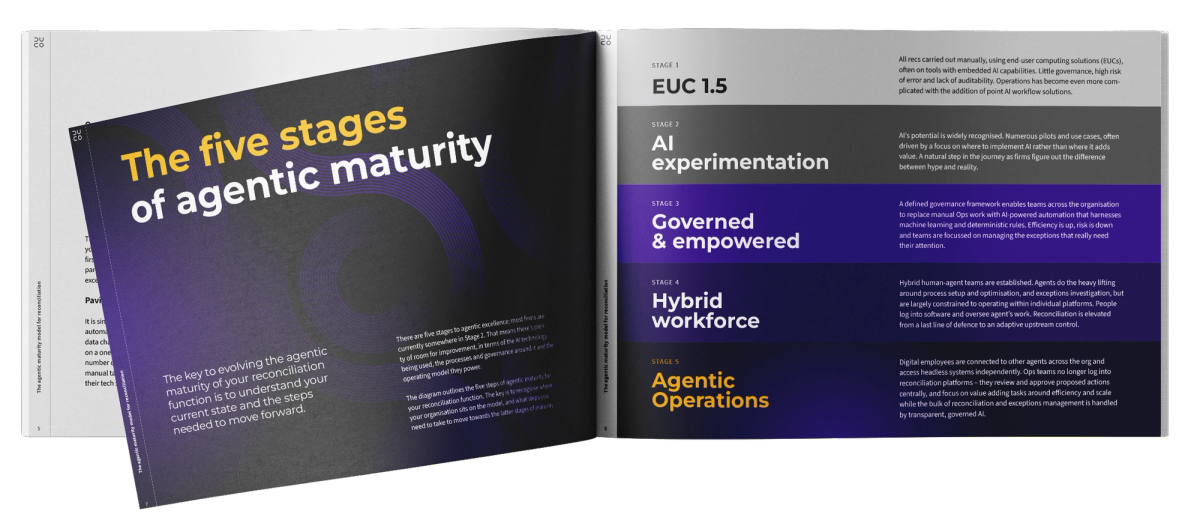
Stage 1
EUC 1.5
All recs carried out manually, using end-user computing solutions (EUCs), often on tools with embedded AI capabilities. Little governance, high risk of error and lack of auditability. Operations has become even more complicated with the addition of point AI workflow solutions.
Stage 2
AI
experimentation
AI’s potential is widely recognised. Numerous pilots and use cases, often driven by a focus on where to implement AI rather than where it adds value. A natural step in the journey as firms figure out the difference between hype and reality.
Stage 3
Governed
& empowered
A defined governance framework enables teams across the organisation to replace manual Ops work with AI-powered automation that harnesses machine learning and deterministic rules. Efficiency is up, risk is down and teams are focussed on managing the exceptions that really need their attention.
Stage 4
Hybrid
workforce
Hybrid human-agent teams are established. Agents do the heavy lifting around process setup and optimisation, and exceptions investigation, but are largely constrained to operating within individual platforms. People log into software and oversee agent’s work. Reconciliation is elevated from a last line of defence to an adaptive upstream control.
Stage 5
Agentic
Operations
Digital employees are connected to other agents across the org and access headless systems independently. Ops teams no longer log into reconciliation platforms – they review and approve proposed actions centrally, and focus on value adding tasks around efficiency and scale while the bulk of reconciliation and exceptions management is handled by transparent, governed AI.
Get the guide
We’re committed to your privacy. Duco will only use the information you provide to contact you about our relevant content, products, and services. You can unsubscribe from our communications at any time. More information is available in our Privacy Policy.
Download your guide to:
- Benchmark your firm against agentic maturity
- Understand how agentic AI impacts technology, people and governance
- Turn your AI vision into a strategic path to ROI