


Reconciliation has always been the control that protects your firm from the consequences of bad data. But the way most teams have to run it has barely changed in decades: spreadsheets, end-user computing tools, and skilled people spending their days matching transactions by hand.
Meanwhile the volume, variety and speed of financial data keep climbing, and AI is raising the stakes. Get your data right and AI compounds your advantage quickly.
Automated reconciliation is the use of software to match and validate data from two or more sources, such as an internal ledger against a counterparty or custodian statement, with little or no manual effort. It ingests and normalises data in any format and matches transactions automatically. Reconciliation is only truly automated when it produces very few or no false breaks, meaning a person can spend their time investigating genuine exceptions. Accuracy and speed no longer pull against each other.
Done well, automated reconciliation frees your teams from repetitive matching, cuts risk and cost, and turns reconciliation from a back-office chore into a strategic control. Done as a scattered set of pilots, it can add a lot of activity without adding much value.
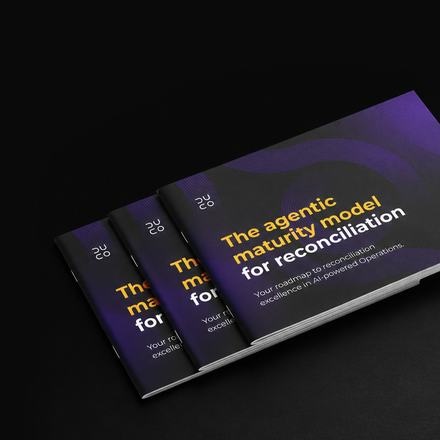
To help you tell the difference, we built the agentic maturity model for reconciliation: a five-stage roadmap from manual, spreadsheet-bound tasks performed by humans to agentic Operations, where AI does the heavy lifting and people provide the critical judgements and insights.
This article walks through what automated reconciliation is, why it matters, and how to conquer the blockers and climb the maturity scale to Stage 5.
Key takeaways
- Automated reconciliation matches and validates data across sources without manual effort, so your teams spend their time on genuine exceptions rather than routine matching.
- The benefits go well beyond speed: lower operational risk, stronger auditability, lower cost, and the agility to absorb new data, asset classes and regulation.
- Our agentic maturity model maps five stages, from ‘EUC 1.5’ to full ‘agentic Operations’. Many firms are stuck at Stage 2, where pilot activity is plentiful, but real progress remains elusive.
- Counterintuitively, firms at Stage 3 often use less AI than those at Stage 2, because open-ended experimentation gives way to targeted, governed automation.
- The biggest blockers are governance, culture and legacy technology. A clear governance framework and the right first use cases are how you move up.
How far have financial firms automated reconciliation?
Reconciliation is still a complex, costly and often opaque task, run through a mix of manual processes in spreadsheets, end-user developed applications, and a patchwork of financial reconciliation tools. ‘Human APIs’ fill the gaps that the systems can't, and every manual step adds the opportunity for error and more work to evidence at audit time.
None of that is a reflection on the people doing the work. It's a reflection on the tools they've been given. Matching transactions by hand simply doesn't scale with rising volumes, a shift towards T+1 and beyond, new asset classes, and tightening scrutiny on data quality.
AI has arrived on the scene, but too often it's bolted onto processes or technology that were designed for a slower, smaller world. The opportunity now isn't to speed up the old way of working. It's to rethink the operating model around it, in order to make agentic Operations a reality.
The key benefits of automated reconciliation
When you move from manual reconciliation to a modern, AI-native platform, the gains compound as you climb the maturity scale.
Speed and efficiency
Every Operations leader will have stories about how many weeks or months it takes to build or change a hard-coded reconciliation process. On a cloud-based, no-code platform it can take days. Using agentic AI to create and iterate on processes pushes the time-to-market down to just hours.
More accuracy, less noise
A best-in-class matching engine, fuzzy matching and user-managed tolerances filter out false exceptions. Even then, there will be distractions for your team. Reconciliation at the later stages of agentic maturity gives the haystack sorting to AI. Your people see the mis-matches that actually matter, not the white noise, which makes automatic reconciliation faster and more reliable than any manual process.
Lower risk and greater trust
Reconciliation software catches bad data before it flows downstream into risk models, capital decisions and regulatory reporting. When you can trust your data, you can trust the decisions you build on top of it. And in a world of agentic Operations, people will be empowered to make a lot more decisions.
Auditability and control
Every action is documented automatically, giving you a transparent, defensible view of the end-to-end lifecycle. You, and your regulators, can see exactly how the data was processed.
Scale and agility
A cloud-native, no-code foundation lets you take on new formats, asset classes and reporting obligations without a major IT project each time. AI can handle everything from file ingestion to matching rules to categorisation. Reacting quickly to changing business demands takes minutes or hours, not weeks or months.
Better work for your people
Perhaps the biggest benefit of automated reconciliation is what it gives back to your teams. Instead of matching transactions by hand, skilled specialists move upstream to fix data quality at source and focus on higher-value work. In the latter stages of agentic maturity, your teams become empowered further, using their operational knowledge to oversee teams of agents and advise the business on best-practice.
The journey from AI-assisted to fully automated reconciliation
Reaching Stage 5 is about more than adding AI. It's about changing how the whole process works, and understanding the technology that makes automated reconciliations possible. It’s also important to note that realising the potential of agentic AI first means building the foundations that enable non-agentic AI tools to flourish.
At its core, automated reconciliation depends on a few connected capabilities.
First, data ingestion and extraction: pulling in structured and unstructured data, from flat, CSV and ISO files to PDFs, emails and images, and normalising it into a common shape. Intelligent document processing handles the messy, unstructured sources that used to demand manual rekeying.
Next, a matching engine combines deterministic rules, fuzzy matching and machine learning to pair records accurately. Then automated exception management workflow labels, comments on and routes the breaks that remain.
Reconciliation touches so much of the firm. There is cash reconciliation, payments reconciliation, securities reconciliation, derivatives reconciliation across both exchange-traded and OTC products, and more. Each has its own quirks, but all of them benefit from the same shift towards automated, governed, AI-driven processes.
It’s now possible for a layer of agentic AI to orchestrate all these steps and work across systems, using governed, auditable tools rather than replacing them. But reaching this point requires moving from manual work and embedded AI functionality to an operating model designed around the autonomous capabilities of interconnected agents.
What automated reconciliation looks like at each stage of agentic maturity
Our agentic maturity model describes five stages. For each one, it sets out the operating model, the role of AI, the people model, the control environment and the performance you can expect, along with the steps to advance. Here's how automated reconciliation shows up as you climb.
Stage 1: EUC 1.5
Many reconciliations are still carried out manually outside of core automation platforms, on end-user computing tools, sometimes with AI features bolted on. Governance is light, the risk of error is high, and auditability is lacking. Adding point AI workflows on top has, if anything, made Operations more complicated rather than less. Performance is limited by how many transactions people can match by hand, and the process is a reactive check rather than a control.
Stage 2: AI experimentation
AI's potential is widely recognised, and pilots and proof-of-concept projects are everywhere. This is a natural and important step as teams sort the hype from the reality, and is where the majority of the industry currently sits. The risk is that experimentation is driven by where to put AI rather than where it genuinely adds value. This means activity rises without a corresponding fall in manual workload, risk or cost. Moving on means building the governance to turn experiments into production.
Stage 3: Governed and empowered
A defined governance framework lets teams across the organisation replace manual Ops work with AI-powered automation that combines machine learning with deterministic rules. Efficiency is up, risk is down, and people focus on the exceptions that really need their attention. Interestingly, firms here often use less AI than those at Stage 2. As the operating model sharpens and the genuinely valuable use cases become clear, effort spent burning through experimentation is replaced by targeted, dependable automation. People shift from data wranglers running tests to decision-makers acting on trustworthy outputs.
Stage 4: Hybrid workforce
Now human-agent teams are established. Agents do the heavy lifting on process setup, optimisation and exception investigation, though they're largely confined to working within individual platforms, with people logging in to oversee and approve their work. This is where reconciliation is elevated from a last line of defence to an adaptive upstream control, catching problems in financial and regulatory reconciliation before they cascade downstream. Performance improves markedly, and the control environment becomes proactive rather than reactive.
Stage 5: Agentic Operations
At the summit, digital employees connect to other agents across the organisation and access headless systems (i.e. software without a user interface) independently. Ops teams no longer log in to reconciliation platforms to do the work. They review and approve proposed actions centrally, while the bulk of matching transactions and exceptions management runs through transparent, governed AI. Freed from the mechanics, people concentrate on efficiency, scale and the decisions only humans should make. Reconciliation becomes an always-on assurance layer over the firm's data.
Blockers on the road to agentic reconciliation maturity
The technology already exists for firms to begin advancing up the reconciliation maturity scale. The desire is there as well, with leadership at most firms backing AI innovation. But progress relies upon much more than just technological capability. The blockers to full agentic Operations are significant - let’s look at each of them, and how you can overcome them.
Governance that lags behind the technology
Progress between Stage 2 and Stage 3 often stalls because of two-speed behaviour. The governance framework built for legacy technology and ways of working is too slow to keep pace with the speed of AI pilots. Innovation quickly stalls when it reaches the point where AI must enter production - without the right control framework, no one is ready to commit to that.
The gap between pilot and production
Pilots and production are very different worlds. Pilots exist in clean environments where everything is carefully curated. Real-world data and processes are messy, throwing up unexpected outcomes. Crossing that gap can feel daunting, and many firms hesitate at the edge of it.
Culture and ways of working
Reshaping how an Operations function works is hard. A reluctance to move away from a human-centred operating model, and the natural caution that comes with change, can hold firms back even when the tools are ready. This is a people challenge as much as a technical one.
Legacy technology
On-premise, brittle and siloed systems weren't built for agents. They're expensive to change and difficult to connect, and they quietly cap how far automation can go. Agents can, in many ways, compensate for the capability gaps in a legacy architecture, but they will never be able to deliver the full agility and transparency required to reach full maturity.
Data quality and trust
Agents amplify whatever you feed them. In a manual pipeline a single data error might affect one trade. In an automated environment, that error cascades at scale, and unresolved breaks compound the longer they exist. Trustworthy, transparent and auditable data isn't a nice-to-have for automation. It's the foundation everything else stands on.
How can businesses overcome these challenges?
The good news is that every one of these blockers has a route around it, and they reinforce each other once you start.
Put the governance framework first, so automation has controls to grow into rather than outrun. With good governance in place, AI Operations become auditable and defensible, your data stays trustworthy, and you gain the observability to catch errors and problematic outputs early.
Design human oversight deliberately. If an agent surfaces every decision at machine speed, people either drown in the volume or start rubber-stamping, which defeats the point. Good human-in-the-loop design uses triage, helps a user understand the downstream impact of an action before they approve it, and makes clear whether it can be undone.
Move onto cloud-native, no-code foundations that agents can actually work with, so cash reconciliation, payments reconciliation, derivatives reconciliation and securities reconciliation all sit on infrastructure built for scale. And benchmark yourself honestly against the maturity model, so you know which stage you're at and what the next concrete step looks like. To see how peers are approaching all of this, our summary of what industry leaders say about building agentic Operations is a useful place to start.
Tips to get you started on automating reconciliations
You don't climb the maturity model in one leap. You climb it by choosing well at the start and building on early wins. Here's where to focus.
Choose the right reconciliation use cases
The fastest way to lose momentum is to point automation at the wrong problem. Start with use cases where the value is clear and the data is available, prove the model, then expand. A few that resonate with most Operations teams:
- Cash reconciliation: comparing internal records against bank and custodian statements, where speed and accuracy directly affect reporting and cash management.
- Payments reconciliation: high-volume, time-sensitive flows where automation removes bottlenecks and reduces settlement risk.
- Securities and position reconciliation: matching positions and transactions across custodians, administrators and internal books.
- Derivatives reconciliation: handling the complexity of exchange-traded derivatives clearing and OTC confirmations without bespoke coding.
- Regulatory reconciliation: validating transaction and regulatory reporting so submissions are accurate and defensible.
Decide your governance model
Before you scale, agree how AI should behave, who signs off on what, and how actions are logged and audited. A governance framework isn't a brake on automation. It's what makes automation trustworthy enough to expand.
Design your operating model and human oversight
Think about the operating model you're building towards, not just the task you're automating. Where should people sit in the loop? What gets escalated, and to whom? Designing this early is what lets you move from a hybrid workforce towards genuinely agentic Operations without losing control.
Benchmark and plan your path
Use the maturity model to establish where you are today and what "good" looks like at each stage. Firms that have made the journey, such as DWS moving from legacy reconciliation to full data automation, show that a clear path and the right foundations make the climb achievable.
Ready to automate reconciliations and move up the agentic maturity model?
Automated reconciliation is no longer just a way to do the same job faster. It's the foundation for a new post-trade operating model, one where reconciliation software works as a proactive, upstream control and your people are freed to focus on scale, efficiency and judgement. The benefits of automated reconciliation software, from lower cost and risk to stronger auditability and agility across cash, payments, securities, derivatives and regulatory reconciliation, only grow as you climb.
The firms pulling ahead aren't the ones running the most pilots. They're the ones with the governance, the foundations and the roadmap to turn automation into a genuinely different way of working. Wherever you sit today, from EUC 1.5 to the edge of agentic Operations, there's a clear next step, and real value waiting when you take it.
To see where your firm sits and what it would take to move up, download the agentic maturity model for reconciliation, or book a demo to see automated reconciliation in action.