


Digital transformation across capital markets has been relentless. Front-office stacks are more sophisticated than ever, levering algorithmic execution, high-frequency trading engines and more. Yet, for many institutional firms, fully automating reconciliation is proving a tough nut to crack.
Most capital markets firms rely on specialised point solutions, often focusing on a single asset class or a specific stage of the trade lifecycle. While these platforms automate the bulk of standard transactions, they create ‘automation gaps’ that middle and back-office teams must bridge. This usually involves manual data entry, pulling reports from custodian portals, or reconciling complex over-the-counter (OTC) derivatives on spreadsheets.
Over time, this results in a ‘spaghetti IT’ ecosystem of disparate platforms and manual ‘shadow IT’ processes. This is the ‘last mile’ of the journey, and has so far resisted all automation efforts.
But why is this still a reality for firms processing millions of tickets? To understand this, we need to look at the unique friction points of institutional trading data.
The five drivers of operational friction in capital markets
While every firm has a unique tech stack, almost all capital markets operations are stymied by five core challenges: variety, change, scale, lifecycle, and control.
These challenges are exacerbated by the industry’s reliance on legacy reconciliation technology. These on-premise, hard-coded systems often require specialised developers for every adjustment and operate on slow 6-to-12-month upgrade cycles.
They are ‘legacy’ not just because of their age, but because they lack the agility required for today’s fast-moving markets.
Let’s take a look at the way the five data challenges confound this technology and the teams who have to work with it.
1. The fragmentation of institutional trading data
Capital markets firms sit at the centre of a web of data. You aren’t just managing internal records; you are reconciling against a vast array of external sources. Central counterparties (CCPs), custodians, prime brokers and counterparties all present data differently. You’re dealing with formats ranging from standardised ISO messages to archaic flat files and proprietary CSVs.
The problem is compounded by the fact that roughly 80% of enterprise data remains unstructured. Critical information is often trapped in PDF capital call notices, email confirmations, or faxes.
Normalising this data to compare it against a global investment book of record (IBOR), for example, is a massive manual hurdle.
2. Navigating market volatility and regulatory shift
Capital markets firms don’t operate in a static environment. Operations teams deal with a daily barrage of changes: from business-level shifts like onboarding new trading desks or asset classes to market-driven changes like complex corporate actions, dividends, and extreme volatility.
Regulation is another constant source of change. The industry-wide move to T+1 settlement, and the evolution of reporting regimes like CFTC or EMIR, are placing Operations under increasing pressure and scrutiny.
Updating a reconciliation rule on a legacy system to accommodate a new regulatory field can take weeks of IT development, forcing Ops to manage the risk manually in the interim.
3. Meeting the demands of a high-volume world
The technology used in many back offices simply isn’t built for elasticity. On a standard trading day, a legacy system might cope, but during a ‘black swan’ event or a significant market spike, transaction volumes can increase tenfold overnight.
Firms cannot simply double their headcount to deal with trade settlement in half the time. The cost would be prohibitive and, even if it weren’t, volume can spike in moments – headcount growth takes months.
All this means, when volume soars, you’re left with an ‘investigation tail’ of breaks so long that it threatens settlement cycles and increases capital charges for trade fails.
4. Maintaining lineage across the global trade lifecycle
Data evolves as it travels from the front-office order management system (OMS) or execution management system (EMS) through to the middle-office and finally to the custodian. This journey sees data transformed, enriched, and often modified in “shadow IT” spreadsheets.
Many capital markets Operations leaders find there are multiple versions of the ‘truth’ circulating their organisation. One team sees a trade from a profit and loss perspective, while another sees it from a risk or settlement perspective.
Without clear data lineage, it becomes nearly impossible to tell exactly where a piece of data originated or why a specific transformation occurred. It’s difficult to maintain a clean golden source for regulatory audits.
5. The change management paradox: Governance vs. agility
Legacy systems are hard-coded, meaning only skilled developers in IT can build or change processes. Ops must document their requirements and wait for their turn in the development queue.
This can take days, weeks, or even months depending upon the complexity of the process and the workload of the IT team.
Operations teams frequently bypass these bottlenecks with ‘temporary’ manual workarounds to meet their deadlines.
In other words, the processes designed to ensure governance and control are at odds with the needs of the business. They often create the very thing they’re trying to mitigate: risk.
Modernising the capital markets operating model
Technological advances are finally enabling firms to overcome these legacy hurdles and rethink their reconciliation function entirely.
Doing so unlocks a more agile operating model where breaks are resolved faster, risk is reduced, and talented professionals can focus on managing the business rather than managing spreadsheets.
It all starts by moving away from hard-coded tools toward no-code, cloud-based platforms. This enables you to empower the people who actually know the data – the Operations and middle-office teams – to build and manage their own controls.
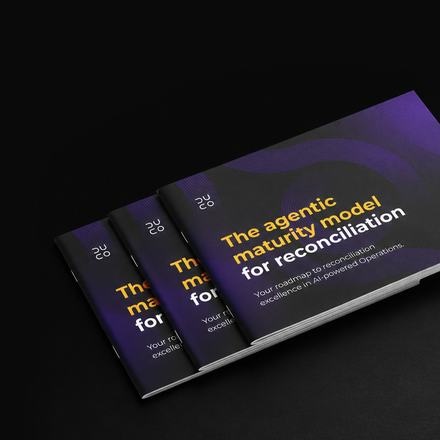
Find out how to advance your organisation along this path with our Reconciliation Maturity Model.