

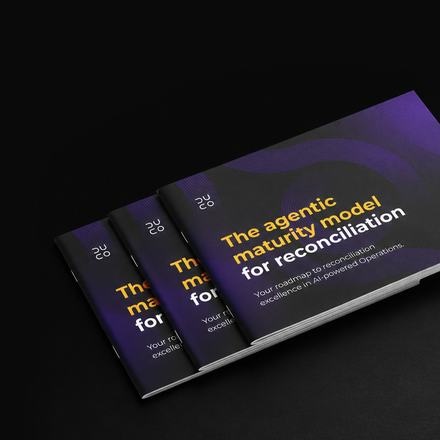

New framework benchmarks firms across five stages of agentic maturity, from AI-supported manual processes to fully agentic post-trade Operations.
London / New York, 1 July 2026 - Duco, the pioneer of agentic Operations for financial services, today published the Agentic Maturity Model for Reconciliation, a best practice framework designed to help COOs and capital markets Operations leaders understand where they stand on the road to AI-powered reconciliation, and chart a clear course forward.
The model, which brings the firm’s previous reconciliation maturity model into the agentic age, comes at a critical inflection point for the industry. Many firms are still grappling with manual processes and rigid legacy tech. Adding AI to that mix in an experimental phase, without a clearly defined governance model and enterprise-wide strategy can increase opacity and risk while simultaneously reducing efficiency and automation. The Agentic Maturity Model gives firms a structured framework to move beyond this status quo.
Five stages: from spreadsheets to agentic Operations
The model maps five distinct stages of maturity:
- Stage 1: EUC 1.5: Manual spreadsheet reconciliation with embedded AI accelerating tasks but deepening fragmentation and governance risk.
- Stage 2: AI experimentation: Pilots are running, but manual work still persists because implementing AI in production remains challenging with clear governance.
- Stage 3: Governed & empowered: A defined governance framework enables AI-powered automation at scale, delivering gains in efficiency, data quality and risk reduction.
- Stage 4: Hybrid workforce: Human-agent teams take shape, Operations teams shift to decision-making and reconciliation becomes a proactive upstream control.
- Stage 5: Agentic Operations: Fully connected agents operate across headless systems at scale.
According to Chief Client Officer, James Maxfield, “Many financial firms are stuck at Stage 2. Everyone’s bought into pilots, but without a proper governance framework, AI tools can run ahead of the firm’s control environment. The result is a false sense of progress: more AI activity, but no meaningful reduction in manual workload, operational risk, or cost. By deploying governed AI solutions, clients can access the full promise of agentic capabilities.”Many financial firms are stuck at Stage 2. Everyone’s bought into pilots, but without a proper governance framework, AI tools can run ahead of the firm’s control environment. The result is a false sense of progress: more AI activity, but no meaningful reduction in manual workload, operational risk, or cost. By deploying governed AI solutions, clients can access the full promise of agentic capabilities.”
From last line of defence to first
Central to the model is a shift in how firms conceptualise reconciliation itself. Traditional reconciliation is reactive, finding errors after they have propagated through systems. Duco’s framework makes the case for a data-centric operating model built around proactive controls, where reconciliation catches bad data before it causes downstream problems.
“The practices followed today have been shaped by systems that haven’t changed much in decades, said Maxfield. “The five core challenges of financial data – variety, change, lifecycle, scale and control – cannot be solved on a one-by-one basis. Agentic AI changes the calculus entirely. Our maturity model gives firms the language and the roadmap to stop patching gaps and start building a genuinely different operating model.”The practices followed today have been shaped by systems that haven’t changed much in decades, said Maxfield. “The five core challenges of financial data – variety, change, lifecycle, scale and control – cannot be solved on a one-by-one basis. Agentic AI changes the calculus entirely. Our maturity model gives firms the language and the roadmap to stop patching gaps and start building a genuinely different operating model.”
Designed for COOs and Operations leaders
The Agentic Maturity Model is designed as a practical benchmarking and planning tool for COOs, Heads of Operations, and senior technology leaders across the buy-side and sell-side. For each stage, the framework outlines the operating model, AI adoption profile, people model, control environment and performance characteristics alongside concrete steps to advance to the next stage.
The model is available to download at du.co/agentic-maturity-model-for-reconciliation/.